AI prediction · Live sports · Monetisation
Designing a real-time AI experience that increased free trial starts by 162%

Overview
RushLine is an AI-first sports analytics platform reimagining how fans follow live cricket. The vision was to build India's most trusted sports prediction and analytics platform by transforming the second-screen experience from passive score tracking into an interactive, insight-driven companion.
This project represents a strategic pivot for a 0→1 sports analytics product.
The challenge wasn't a lack of data, but a perceived value gap. While the AI was generating accurate predictions, users weren't converting from free to paid because the insights lacked context, emotional resonance, and a clear "why."
By owning the AI insights layer, fan-biased commentary, and player predictions experience, I helped shift the product from a raw data utility to an emotionally aligned sports companion.
Why it mattered
Challenge
We validated multiple monetization models—from pay-per-match to subscriptions—but users converted without returning. Research revealed the issue wasn't pricing or onboarding friction. Users struggled to understand the value of AI-powered insights and defaulted to existing match-following habits.
Breakthrough
A failed free-trial experiment changed our thinking. Removing the card requirement increased low-intent users instead of engagement. The real challenge wasn't convincing users to pay—it was becoming part of their existing match-following journey. This insight reframed the entire product strategy.
Outcome
I redesigned the live match experience around habit, context, and emotional engagement, transforming AI predictions from a standalone feature into a second-screen companion. The redesign led to 162% more free-trial starts, 5× higher time spent, 2× feature adoption, and D7 retention improving from 32.6% to 51.8%.
Problem
The Challenge
When I joined RushLine (formerly CriQ), the team was validating whether users would pay for sports intelligence.
To validate this, we focused on rapid experimentation instead of building a polished subscription experience from day one.
We experimented with multiple monetization strategies, beginning with paid match predictions that generated ₹10,000 in the first week.
Although early traction looked promising, growth wasn't sustainable.
Hypotheses
Validating Willingness to Pay
To test this, we introduced a subscription model and we removed the credit card requirement from the free trial.
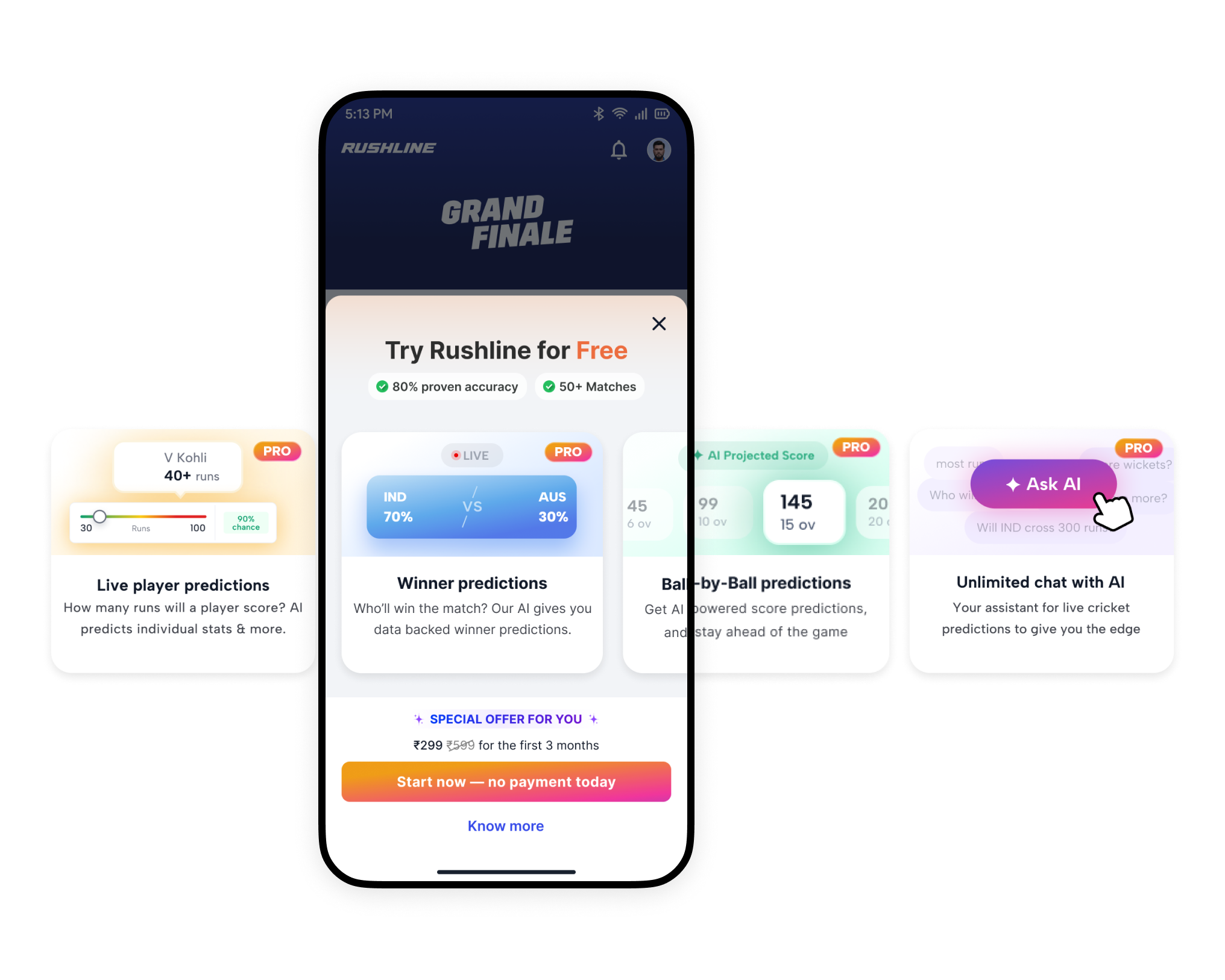
Result
Trial sign-ups increased.
Paid conversions barely changed.
Learning
Removing friction attracted more users—but they weren't committed users.
The credit card requirement had unintentionally acted as a commitment filter.
The issue wasn't friction. It was intent and perceived value.
100%
Homepage
25%
Start Trial Clicked
3%
Free Trial Started
10%
Paid User
Research
User Feedback
Interview: 30 min
32 Calls
Interview: 30 min
5 In-person
Form: 5 min to finish
160 Surveys
We conducted user interviews, analyzed behavioural data, and studied conversion funnels.
One insight appeared repeatedly.


Chinmay, casual fan
I don't want to pay before I know it's worth it.
Arjun, fantasy player
I get confused during live matches; I go to Cricbuzz to check toss, pitch, and weather.
Rohan, trial user
AI predictions feel random until I see them hit a few times in a row.
Dev, churned user
If it doesn't tell me why the prediction matters, I ignore it completely.
Priya, IPL follower
I will think about spending money only after I trust the predictions.
Tushar, subscriber
Manually switching between score apps and prediction tabs kills the flow.
Sourab, power user
Critical changes like wickets and boundaries need to be notified instantly.
Krish, Sports investor
When I miss a part of the match, I don't want to read long articles to catch up. I just want a quick way to understand what's happened - the excitement fades by the time I've read everything.
Users weren't rejecting the product. They simply couldn't understand its value quickly enough.
Insight
We Were Solving the Wrong Problem
Users also said something even more important through their behaviour.
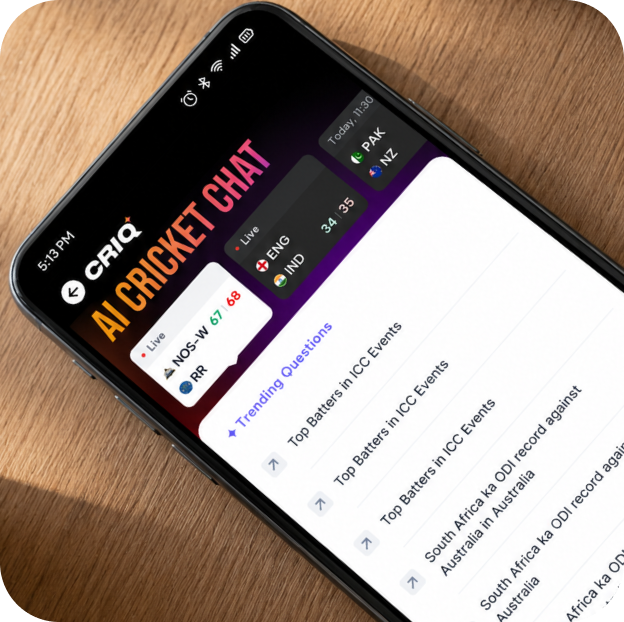
Whenever a match started, they instinctively opened Cricbuzz.
It wasn't because it offered better predictions. In fact, it didn't offer predictions at all
Because it had become their default habit.
We weren't just competing with another app. We were competing with years of user behaviour.
User persona
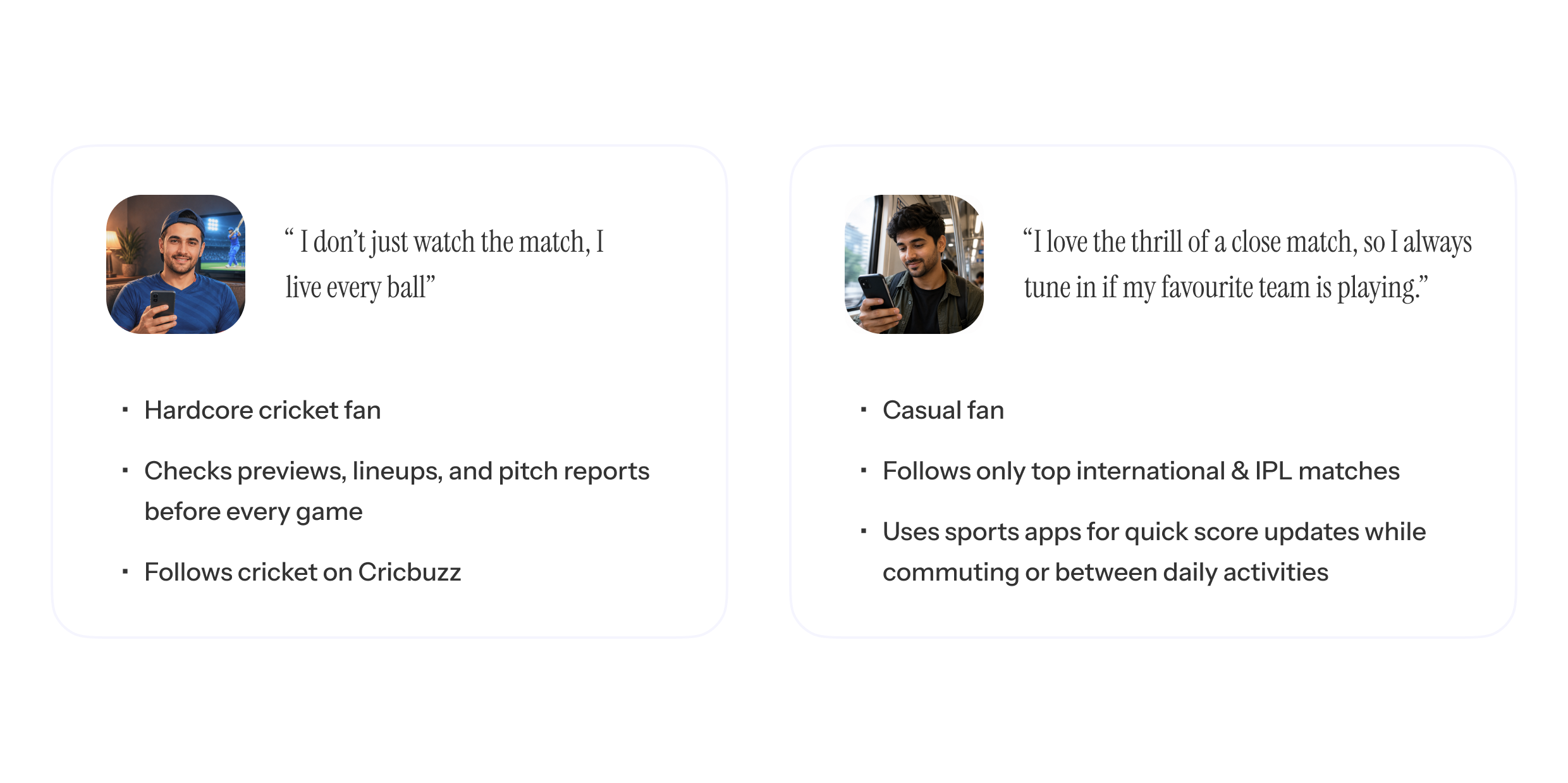
User Persona
Goals
Defining success before pixels
We aligned on three product goals and measurable outcomes before moving into design:
Impact
Success metrics
- Primary: Free trial activation rate & New paid users
- Secondary: Avg. session duration on live commentary tab
- Guardrail: Trial cancellation & negative customer feedback
- Adoption & Retention: How many users come back after experiencing AI commentary for the first time
Iterations
Key design decisions
I reframed the problem across three distinct layers to move beyond "UI polish":
The Trust Layer
How might we make AI feel trustworthy without exposing the complexity of the underlying system?
The Anticipation Layer
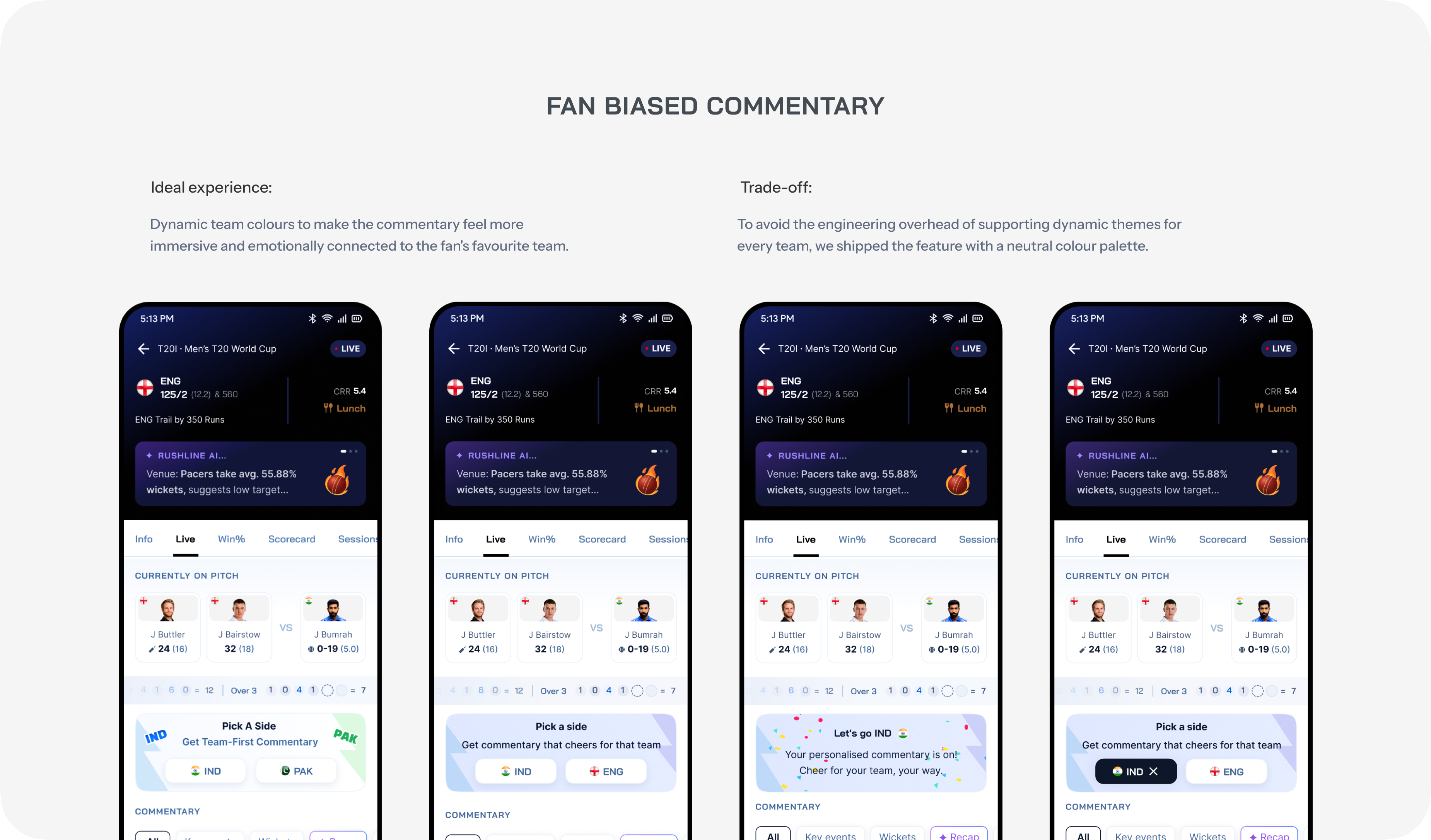
Sports are inherently biased. Neutral AI commentary felt cold and disconnected from the high-stakes reality of a live match. How might we personalize AI without compromising factual accuracy?
The Conversion Layer
How might we expose the product's unique intelligence at the moment users are most likely to convert?
Pre Redesign
Trial conversion: 2.7%
Home Page
Tap Match Card
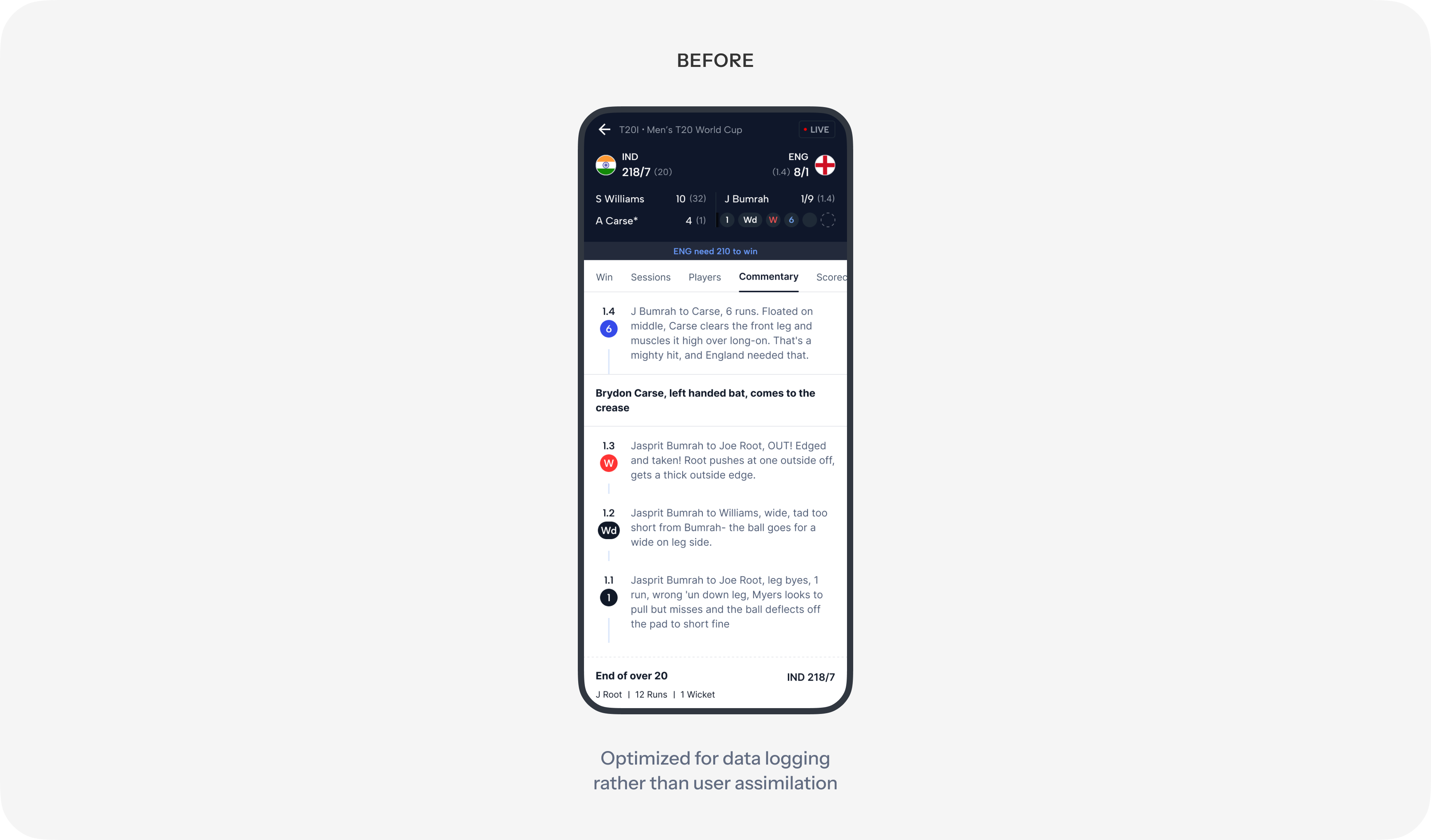
Generic Commentary
Locked Win Prediction
Start Free Trial
Plan Selection
Drop-off Point
Enter Payment Details
Confirm Trial
Trial Completion
Post Redesign
Trial conversion: 7.8%
Home Page
Tap Match Card
Unlocked Live Match Screen
AI Commentary
Inline Predictions
Contextual Free-trial CTA
Plan Selection
Enter Payment Details
Confirm Trial
Trial Completion
Exploring directions
Monetisation
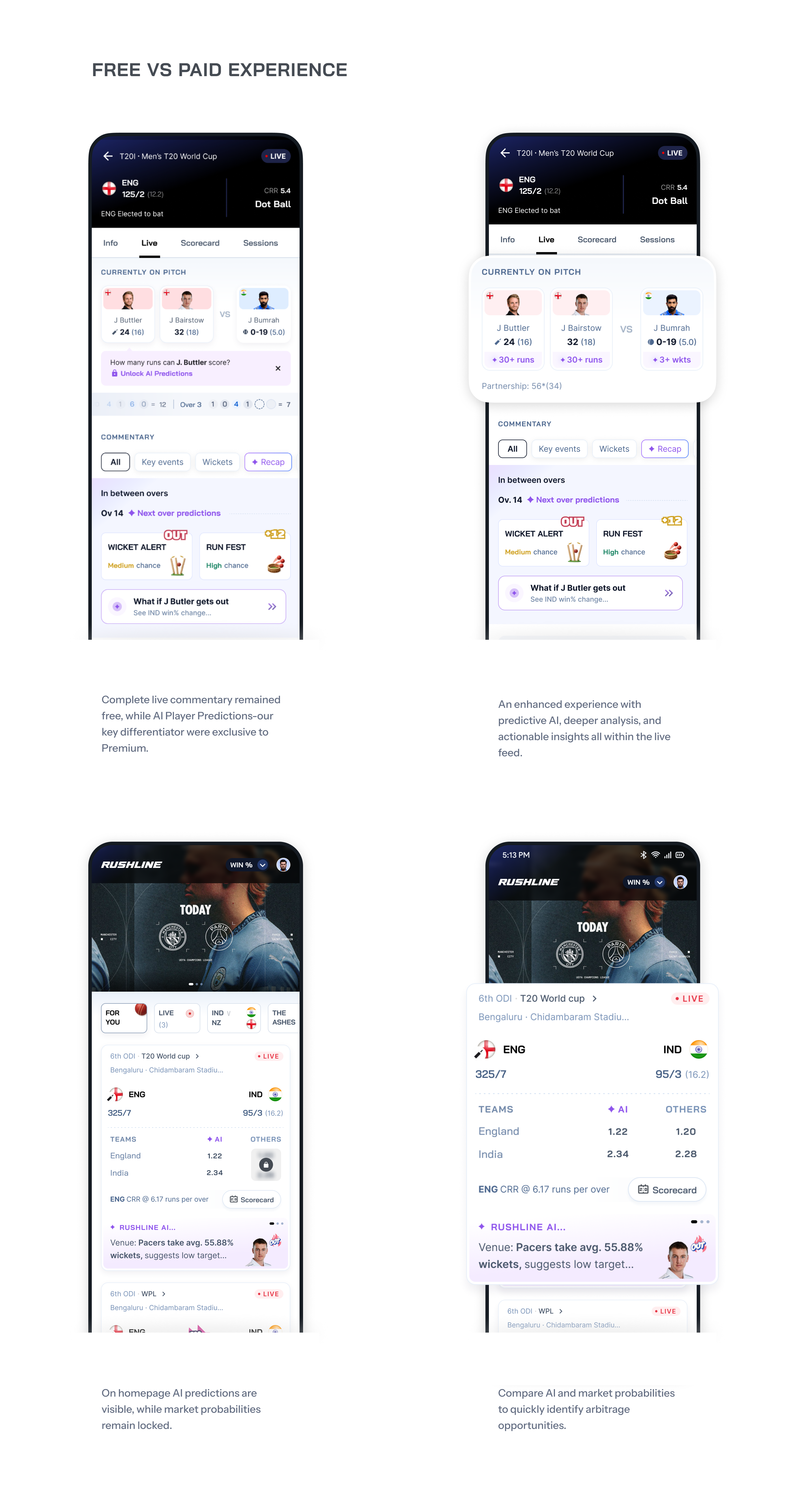
Free vs paid experience
Key product questions to solve were:
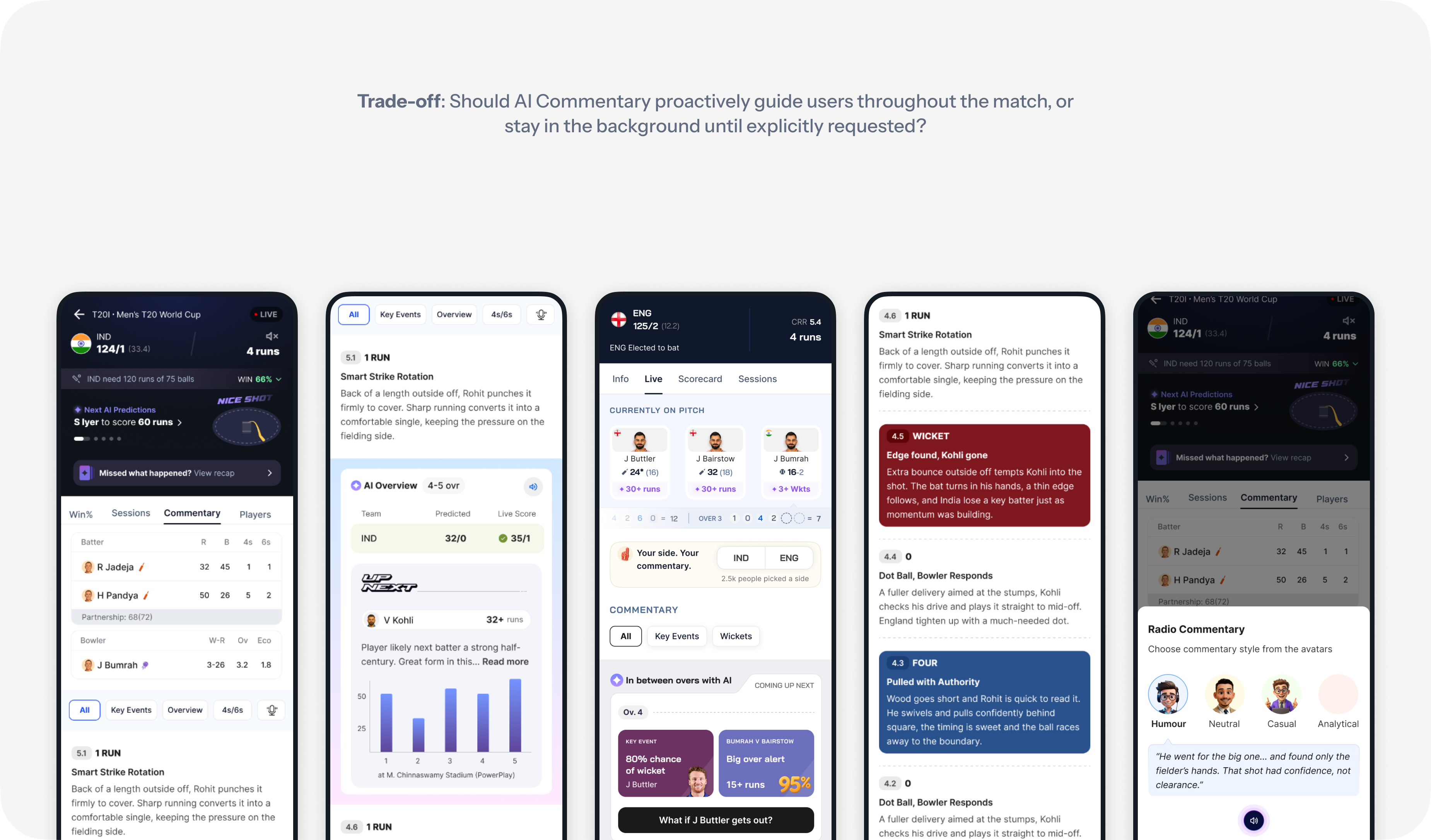
1. When should we interrupt users? We needed to identify high-impact moments that added value without overwhelming users.
2. How should commentary adapt to different fans? A casual fan, a fantasy player, and a die-hard supporter all seek different levels of detail, tone, and bias.
3. How do we combine live events with predictive insights? Instead of describing what just happened, we wanted to predict what can happen in the next over to make the match more engaging.
4. How do we keep commentary trustworthy at live-match speed? The experience had to feel instant while remaining accurate, contextual, and consistent as the game evolved.
Outcome
These constraints ultimately guided us toward a solution that delivered contextual AI insights with minimal engineering effort, low latency, and a simple, focused user experience.
Approach
Designing for an AI System, not just an Interface
AI commentary in sports works by analyzing real-time game data, converting it into natural-sounding commentary, and delivering it through text-to-speech technology. This enables consistent and energetic on-demand sports commentary.
Live Match Events
Context Engine
- Live Score
- Player Stats
- Match History
- Base Commentary
AI Commentary Engine
Grounding Validation
Commentary API
Rushline AI
Rather than generating commentary from a prompt alone, the AI was grounded using multiple trusted data sources before the response reached users
AI design principles
- Ground before generate
- Separate prediction from commentary
- Context over creativity — rather than maximizing creativity, maximize relevance.
Grounding & hallucination control
What happens if...
If
Kafka event delayed?
Then
Don't show prediction.
If
Historical DB unavailable?
Then
Generate only live commentary.
If
Prediction confidence below threshold?
Then
Hide prediction.
If
Grounding check fails?
Then
Fallback to SI commentary.
Final solution
Commentary that earns attention
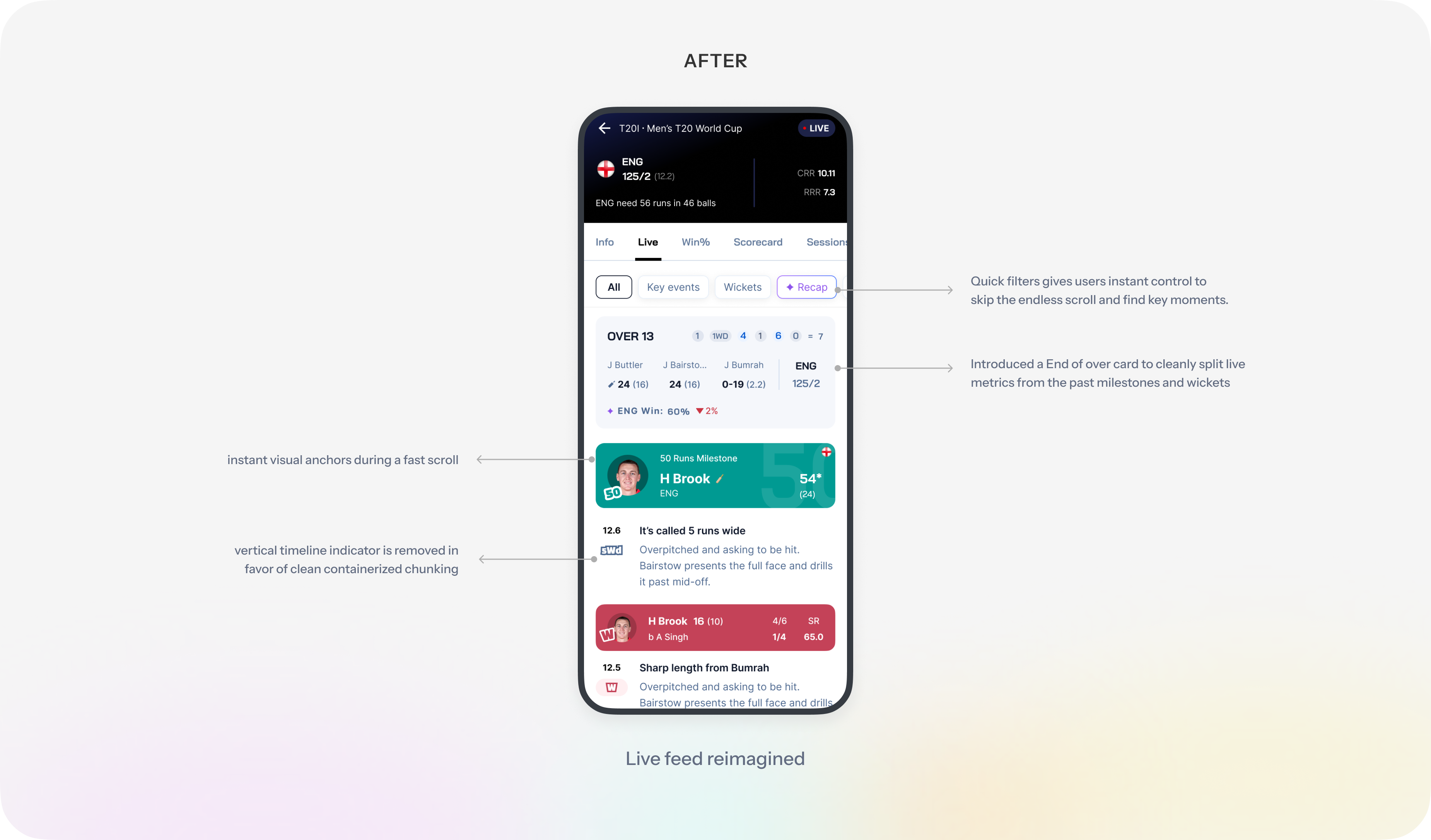
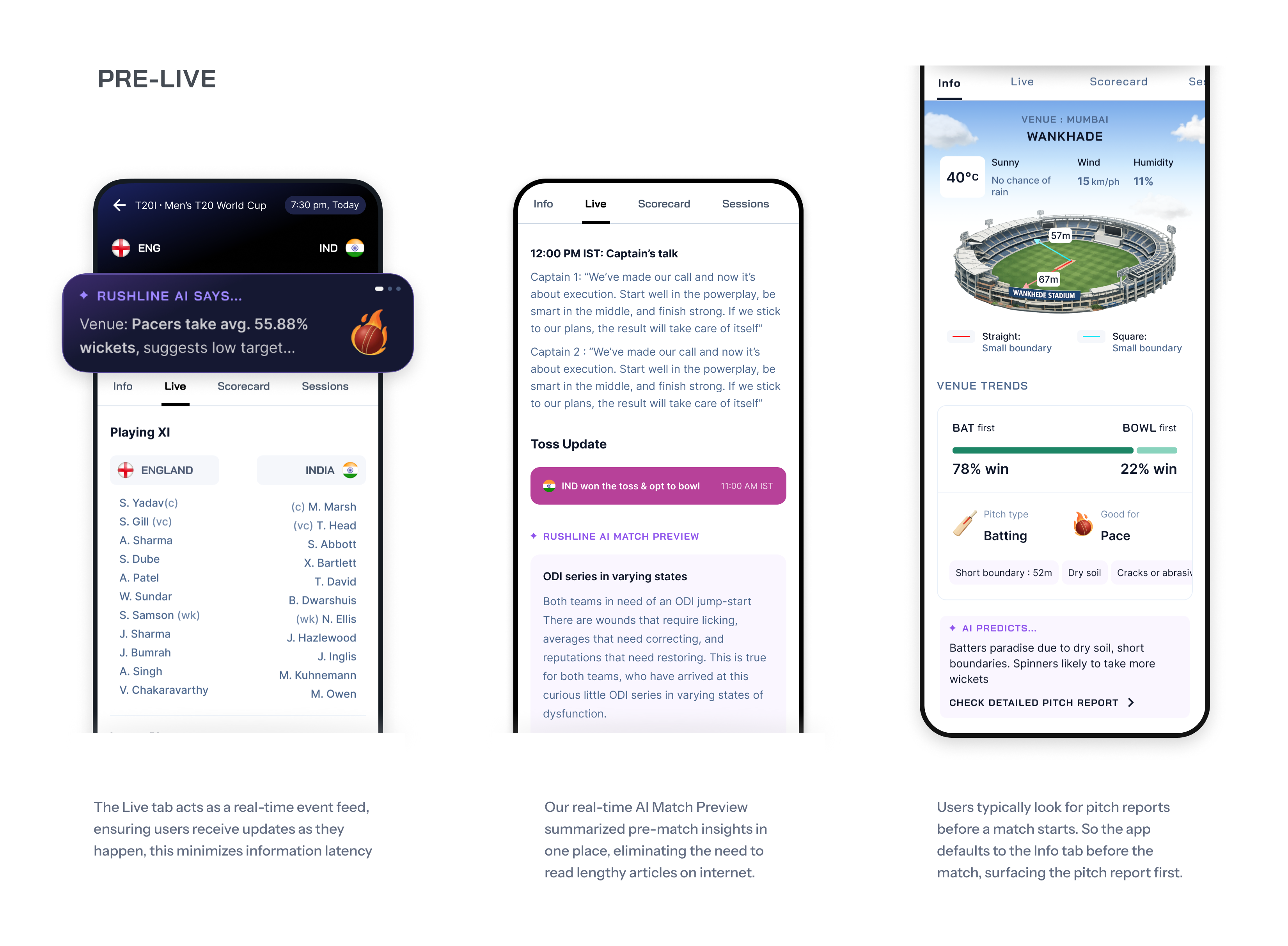
The final experience layers AI commentary into the live match centre without competing with the scorecard. Each card follows a consistent structure: headline prediction, one-line rationale, and optional expand for deeper analysis.
A subtle warm gradient behind cards ties the feature to the premium tier without breaking the app's neutral palette. Motion is restrained—cards slide in from the bottom with a gentle fade, respecting the urgency of live sport.

Pre-live story
Outcomes
Impact that moved the business
The redesign moved the needle on the most critical growth metrics:
7.8%
Free Trial Starts
30%
Feature Adoption
~16 min
Average Time Spent
51.8%
D7 Retention
~87/day
New paid users post redesign
Conversion Power: Free Trial Availed jumped from 2.67% → 7.00% (+162%). This validated that surfacing the value of the AI early was more effective than any pricing change.
Stickiness: DAU stabilized at ~10,118, up from a pre-redesign average of 5,000. The "weekend effect" (peaking at 31k) showed that our AI became a "second screen" staple during live events.
Monetization Baseline: We achieved a steady growth of ~87 new paid users/day, proving the 0→1 model was ready for scale.
Key learnings
Reflections
This project reinforced that AI product design is as much about pacing and trust as it is about model quality.
- Narrative beats numbers- users engage with stories, not confidence intervals
- Preview the premium experience during peak emotion, not at onboarding
- Design for interruption- live sport is chaotic; UI must be glanceable
- Cross-functional alignment early prevents costly pivots late in the cycle
AI features don't succeed on intelligence alone. They succeed when the experience feels human, timely, and worth coming back to.